Hiring a data analyst, an engineer, a support agent, a product manager?
Every candidate who uses AI looks the same. Steer shows you who actually did the thinking.




Before AI
The hiring funnel did its job.
Each stage adds a little signal.
A simulated workday that tests multiple skills.
A real problem, not a puzzle
The task is a real company problem, with realistic data and real context: the kind of week-one work the role actually exists to do. Not a brain-teaser, not a coding quiz.
A workplace, not a test window
The whole job is simulated: a database to query, SQL and Python to work it, an AI assistant, and virtual colleagues who each know their own part of the story. Nobody has the full picture, just like in real life. All of it runs in one browser tab: one link per candidate, nothing to install.
The process is the signal
The candidate submits their final work, as they would anywhere. But every prompt, query, message and revision is recorded along the way, so you also see how they got there: the thinking, the checking, the dead ends. The output alone can be all AI. The process shows who did the thinking.
A brief built for the interview
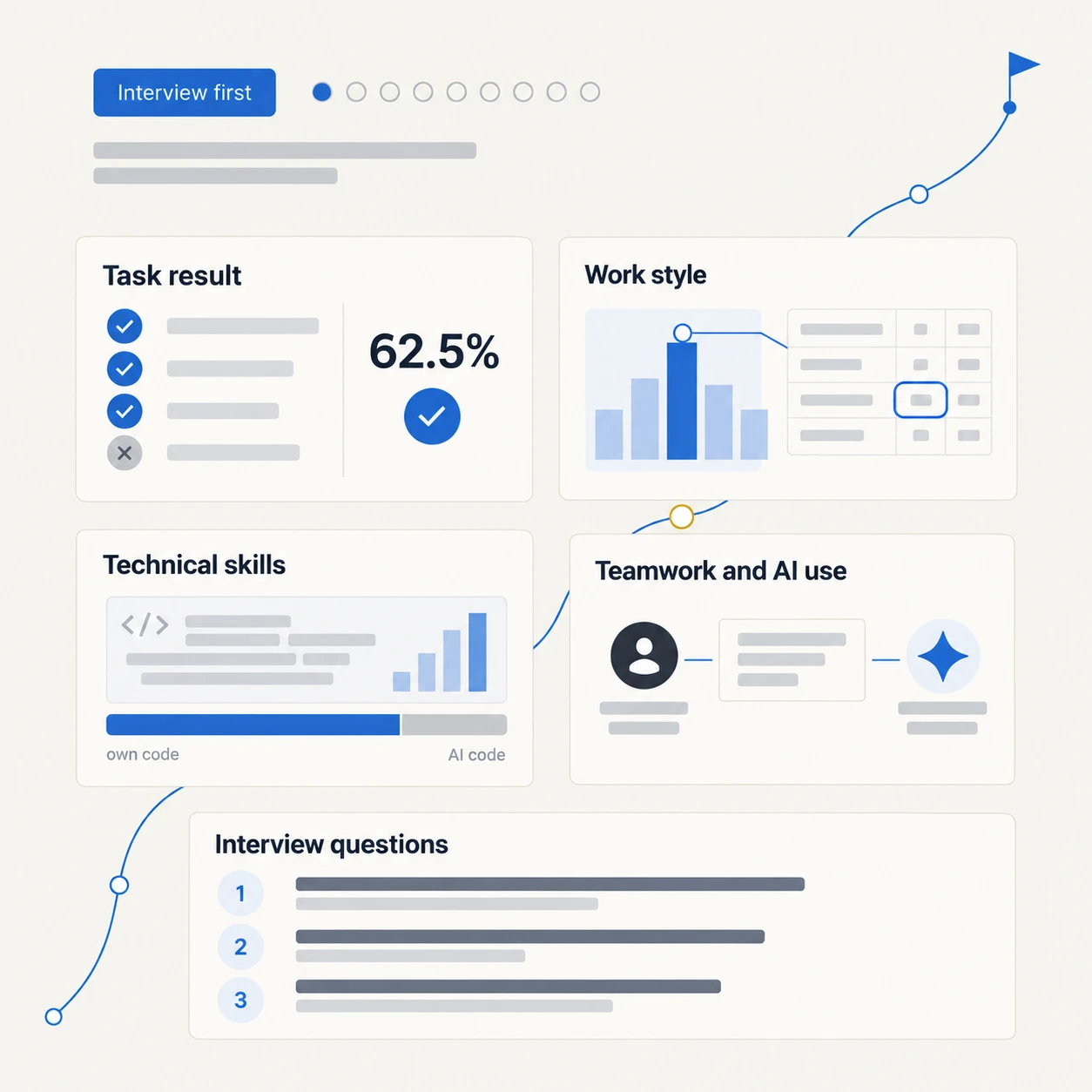
You get a full brief on the candidate: where they were strong, which parts of the task they handled well and which need a closer look, and the interview questions worth asking, each backed by the recorded evidence.
Know who to talk to first, and what to ask.
Every candidate gets one short report. It tells you:
- How they did compared with your other candidates, and why.
- What they did well and where they slipped, each point linked to the moment in the recording that shows it.
- The interview questions worth asking, and what a good answer sounds like.
- And, whenever you want it, the full playback of the session: what they did, how, and when.
You see how the person actually thinks: what they checked, whom they asked, what they took on faith. Ten minutes of reading, and you walk into the interview knowing what to test, instead of guessing from a polished take-home.
Messy on purpose, because work is.
Every number can be checked
We plant a false claim in the assistant's output, and the data carries real defects an honest analysis has to notice. A superficial pass looks right. The candidate who checks stands out.
Colleagues with their own minds
Every colleague holds a different slice of the truth: some volunteer it, some wait to be asked. Who the candidate asks, and what they double-check, is the record.
Real tools, real choices
SQL and Python for those who dig; the assistant writes code for those who don't. The signal: did they check what the assistant handed them, or build on it as-is?
Ten roles. Each one gets its own workday.
No generic test. Every role runs a scenario built for that job: its own task, its own data, its own colleagues, its own traps. A support agent handles a disputed charge, an engineer finds a bug in the data, an analyst decides whether a promo is working.
- Data analysta promo diagnosis
- Software engineera bug in the data
- Product managerthe auto-renew experience
- Customer supporta disputed renewal charge
- FP&A analysta billings variance
- Analytics engineersubscription dbt models
- UX designera renewal-flow critique
- Marketinga promo that may not be working
- Project managera migration status for Thursday
- SDRinbound lead qualification
- Your role?scenarios are built per company · ask us
We've sat on your side of the table.
Steer is built by people who have hired for these exact roles themselves (data analysts, developers, designers, product managers, operations) at Revolut, Printify, Printful, and Twino, and for companies of their own. We know what a stack of polished, identical, AI-assisted take-homes feels like. Steer is the tool we needed and couldn't find.
Candid with candidates, too.
No webcam, no lockdown
No proctoring, no full-screen jail, no webcam. Everything runs in one browser tab: one link per candidate, nothing to install.
Their evening is respected
Tasks can be time-boxed, with the clock visible the whole way, and come in different lengths to suit the role. The report shows how long each candidate actually spent, and everyone gets the same task and the same clock, so nobody wins by giving up their weekend.
The work, not the person
We record prompts, cells, and revisions: the process, never the human behind it.
Identity-blind by design
No name, CV, or photo ever enters the record. The system reads work it cannot attach to a person.
Feedback worth passing on
The report's strengths and gaps are written in plain words, so you can share what stood out with the candidate, if you choose to.
Stop walking into interviews blind.
Know what your candidate actually did before you meet them. Book a 30-minute demo on a role you're hiring for right now.
See a real interview brief on a candidate of your own.
30 minutes. We run one of your open roles through Steer and walk you through the brief.